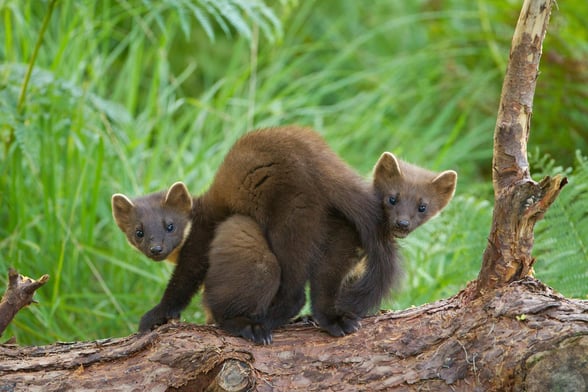
Pine marten conservation
Discover what is being done to ensure the survival of pine martens
The conservation effort
The pine marten is one of the rarest native mammals in Great Britain. It was once found across the UK but during the 18th and 19th centuries its numbers declined rapidly. This was mainly due to deforestation and game shooting; up until Victorian times the pine marten was also hunted for its beautiful fur. Today, pine martens and their dens are offered full protection under the Wildlife and Countryside Act (1981) and the Environmental Protection Act. Historically, they were pushed to the more remote parts of the UK, becoming Britain’s second-rarest native carnivore.
Eventually, their only remaining stronghold was in the North-West Highlands of Scotland, but now things are looking up for the pine marten. Changes to the management of Scottish landscapes over the past few decades have created conditions that have allowed the pine marten to thrive. They are now in relatively high densities in the Highlands, though still relatively rare in Southern Scotland. Katy Anderson, Habitats Manager of Cowal & Trossachs Forestry Commission says: “Pine martens have made a comeback over the past 12 to 15 years. Prior to that there weren’t many in this area due to a long history of persecution by gamekeepers. Since game-keeping decreased and forest areas have increased, pine martens have recolonised the Trossachs and areas across Scotland.”
The feasibility study
The feasibility study was a collaboration between Gloucestershire Wildlife Trust, Forestry England, and the Vincent Wildlife Trust. Forest Holidays is the first key sponsor of the project and is keen to contribute to the survival of this iconic woodland species. The feasibility study assessed whether there was suitable habitat for pine martens in the forest and whether a sustainable population could exist. It also investigated the impact pine martens may have on the local ecology of the area; the reintroduction of a native predator can have extremely positive effects on an ecosystem, helping re-establish balance. In particular, pine martens are potentially the perfect ally in the fight to reduce grey squirrel populations, which damage trees and threaten red squirrels.
All native species within the forest evolved alongside pine martens, however, it was important to thoroughly assess their potential impacts on rare and protected species of conservation concern. Local communities were also fully consulted about living alongside pine martens. This exciting feasibility study took two years to complete and as a result, 18 pine martens have successfully been reintroduced into the Forest of Dean. They have been fitted with tracking collars so that their activity can be closely monitored, our Forest Ranger, Gerry has been volunteering for the Gloucestershire Wildlife Trust to help with the radio tracking. There is hope that over the next two years more pine martens will be released into the Forest of Dean and that a population will establish there, so we look forward to providing more updates in the near future.
- Strathyre, Ben Ledi
Changes in forest management
Pine marten numbers have been helped by the way that forests have been restructured over the past 30 years. The removal of conifers (a single crop species) and their replacement with more diverse native species suits the pine martens’ preference for mixed woodlands. When undertaking forest operations, Forestry England, Forestry and Land Scotland and Natural Resources Wales are careful to survey for den sites, particularly in the breeding season and they have also provided boxes for breeding, safe from foxes, one of the pine marten’s main predators. The young are born in April and are very dependent on their mothers so it’s important that they are not disturbed.
Strathyre, Ben LediPine martens in England and Wales
Pine martens could easily find suitable habitats in England and Wales but the current tiny populations are thought to be too small to survive on their own and it will be many years before the Scottish population expands to link with them. Conservationists are lending a helping hand and have already started a programme to help pine marten populations recover. At Forest Holidays, we have supported investigations into the feasibility of re-establishing a population in the Forest of Dean. This ‘translocation’ as conservationists call it, along with successful reinforcement of Pine Marten populations in other previously occupied areas of England and Wales, will be a major step towards improving their conservation status.